Why are so many Indian Hindus today so vocal about their hatred for Palestine?
To understand that, we need to understand the parallel ideologies, playbooks, and common “enemy” of Zionism and Hindu nationalism, also known as Hindutva.
For a comprehensive overview on the ideology and its harms, read IMAM’s explainer titled “How to Talk About Hindutva.” For an in-depth look at the rise of Hindutva over the past century, check out IMAM’s article series “Hindutva 101: A Timeline.”
Below is a brief breakdown on the history and ideological framing of Hindutva.
What are the ideological parallels between Hindutva and Zionism?
Hindutva’s core views can be boiled down to a few key points:
- •India belongs to Hindus
- •Hindus (especially upper-caste Hindus) are by default superior over non-Hindus
- •Minorities, specifically Muslims, should be stripped of their human rights, reduced to second-class citizens, and subjected to mass violence
- •India should be a Hindu theocratic ethno-state, instead of a secular democracy
Compare this to the key elements of Zionism:
- •“Israel” belongs to the Jewish people
- •Jews are by default superior over non-Jews in “Israel”
- •Palestinians should be stripped of their human rights, reduced to second-class citizens, and subjected to mass violence
- •“Israel” should be a Jewish theocratic ethno-state
There are also parallels in the common talking points deployed by Hindu supremacists and Zionists to defend their supremacist worldview.
For Hindu supremacists:
- •Hindus are in danger, and therefore need their own ethnostate to be safe
- •Hindus are being assailed on all sides by Muslim enemies
- •Hindus, despite being in the majority in India, are the underdog
- •Criticism of this worldview is Hinduphobic
Similarly, for Zionists:
- •Jews are in danger, and therefore need their own ethnostate to be safe
- •Jews are being assailed on all sides by Arab/Muslim enemies
- •Jews, despite establishing apartheid against Palestinians, are the underdog in the region
- •Criticism of this worldview is antisemitic
As Azad Essa tells +972 Magazine, “Indian and Israeli leaders both tend to code switch when explaining their goals to different audiences: to international audiences, they speak of terrorism, self-defense, and peace; domestically, meanwhile, they talk about expanding borders, while allowing their surrogates to spout hate speech about Palestinians or Indian Muslims or Kashmiris.”
Essa adds, “Both Zionism and Hindutva are very exclusionary and work toward an ethnocracy where there is only one ethnicity, one idea of the nation, and one language. A settler project derives political and economic advantages through erasure. There are even suggestions that India may be headed toward a full-blown apartheid state, too.”
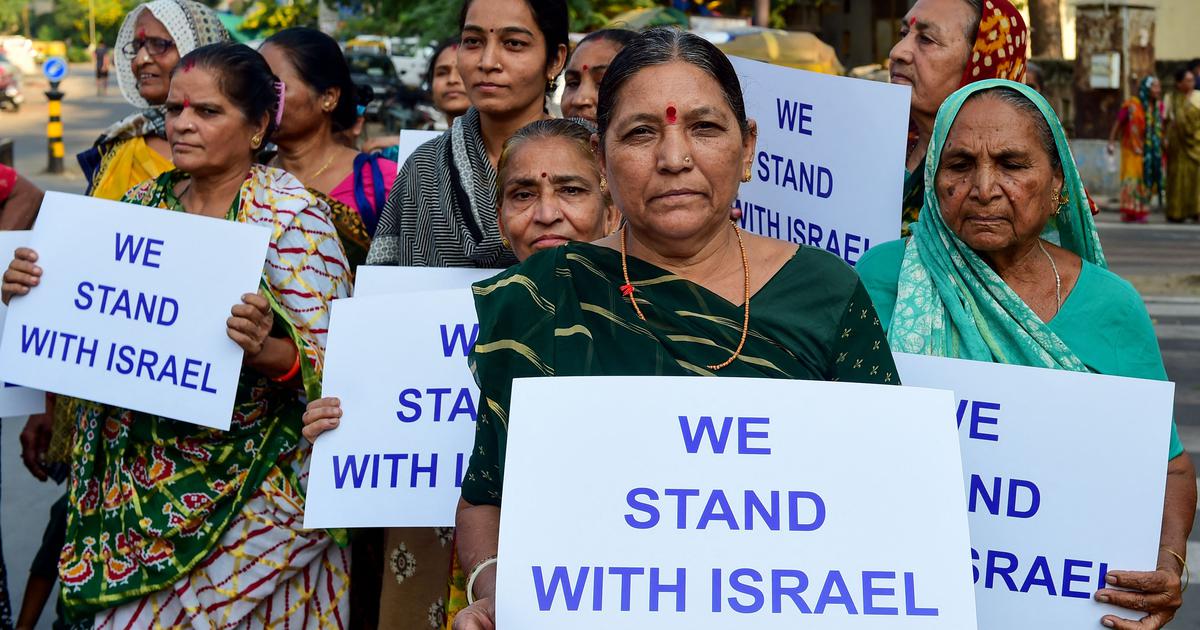
Why do Hindu supremacists continue to show fervent support for Zionists?
Zionists don’t show any reciprocal respect to Hindu supremacists — in fact, they’re often racist to Indians.
The answer can be summarized in this paragraph Ahmed writes for Jacobin Magazine: “Present-day Hindutva supporters see a reflection of themselves in Zionist demands for a Jewish state at the expense of Palestinians. Both ideologies rely on religious and racial supremacist narratives to declare the need for their own state; both claim that outsiders have defiled their ancient homelands; both engage in pinkwashing to paint their own group as morally superior to the ‘barbarians.’ And while Zionists have not declared Islam itself as their enemy (despite their documented links with the global Islamophobia industry), this caveat hardly matters to Hindutva supporters when both ideologies also require stoking hatred for Muslims, dehumanizing them as threats standing in the way of the creation of a homeland.”
One can see this thought process referenced by leaders of India’s ruling Hindu supremacist party. Politician and actress Kangana Ranaut professed it openly when she met Israel’s ambassador to India, Naor Gilon, in 2023: “That they can’t give us [each of Hindus and Jews] one land is inhumane and stingy of the Islamic world. . . . Today, the whole world, especially Israel and India, are fighting their war against terrorism.”
Essa emphasizes this as well: “At the heart of this new alliance is Islamophobia, and [the fact] that both Zionism and Hindutva are pushing colonial and expansionist ideas. Both are ethnonationalist ideologies with an emphasis on race, territory, and nativism.”
How have Indian politicians weaponized October 7th against Indian Muslims?
The BJP government capitalized on the events of October 7th as a way to demonize Muslims globally.
Safa Ahmed writes for Jacobin Magazine, “When [Modi] declared that India ‘stands in solidarity with Israel’ on October 7, and powerful politicians linked with the ruling party claimed India faced similar threats, it was seen as a green light by the Hindu right’s powerful internet ecosystem to conflate Islam, Palestinians, and terrorism as a singular demonic entity that threatens India and Israel alike, using disinformation as ‘proof.’”
BJP leaders have amplified this narrative for domestic gains, increasing the threat of violence toward an already battered population of two hundred million Indian Muslims, who already face regular mob violence, lynchings, threats of sexual violence, criminalization of religious expression, attacks on citizenship rights, and illegal home demolitions.
A senior BJP leader, Basangouda Patil Yatnal, claimed that India “may face the situation that Israel is confronting today if we don’t stand up against politically motivated radicalism.” Another BJP leader posted a video of a pro-Israel rally showing Hindu supremacists chanting, “The battle lines are drawn clear, Israel is our friend,” as a direct contrast to pro-Palestine rallies led by Indian Muslims.
These rallies are the subject of a government crackdown, where largely Muslim protesters are assaulted, arrested under criminal charges, and labeled as anti-India terrorist sympathizers. Even beyond protests, Muslim support for Palestine is treated as criminal activity: four men were arrested simply for waving the Palestinian flag at a cricket match in Kolkata; an imam was arrested for making a prayer for Gaza in a mosque in Kanpur, Uttar Pradesh; and major mosques in Kashmir have been shut down on Fridays as a preventative measure to nip pro-Palestine rallies in the bud.
Online, the disinformation campaign against Palestine is used by Hindutva supporters to fan the flames of Islamophobia globally. Far-right Hindu Twitter/X users consistently inundate the platform with the hashtag #IslamIsTheProblem under posts related to both India and Israel, reinforcing the dangerous Islamophobic stereotype that Muslims pose an existential threat to all other groups.
If the still-fresh genocide of Rohingya Muslims in Myanmar holds any lesson, it’s that online hatred rarely stays online. It radicalizes societies, leads to violence, and then allows for the glib justification of mass atrocities against victim groups.
How do Hindu supremacists replicate Zionist tactics of repression on Indian Muslims?
The playbooks used by both movements are similar, with the Hindu right often implementing Zionist tactics to legitimize their movement in the diaspora.
Ahmed writes for Yaqeen Institute: “Both groups weaponize their minority status to provide cover for their bigotry, conflating their religious identity with their supremacist politics. Where Zionists cry ‘antisemitism’ any time Israel is criticized, Hindu supremacists hurl bad-faith claims of ‘Hinduphobia’ against those who criticize Hindutva, Hinduism, and the Modi government. Like Zionists, Hindu supremacists also weaponize the language of social justice and exaggerate claims of victimhood, referring to their ethnosupremacist and expansionist ideals as ‘decolonial’ or acts of ‘protection’ for the entire community.”
She continues, “So promising is this partnership in the eyes of the far right that David Brog, former Executive Director of Christians United for Israel (CUFI), wrote an essay in Jewish Journal that declared, ‘Jews and Hindus can be the core of such a new alliance’ to push back against ‘radicals’ and ‘race baiters.’ Mihir Meghani, cofounder of Hindu American Foundation, added an explicitly anti-Muslim angle to Brog’s vision when they appeared as guests on a podcast, saying, ‘Clearly the Arab and Muslim immigration has overtaken the Hindu and Indian community . . . and [is] perhaps approaching the Jewish community population, so we’re gonna need to forge these alliances.’”
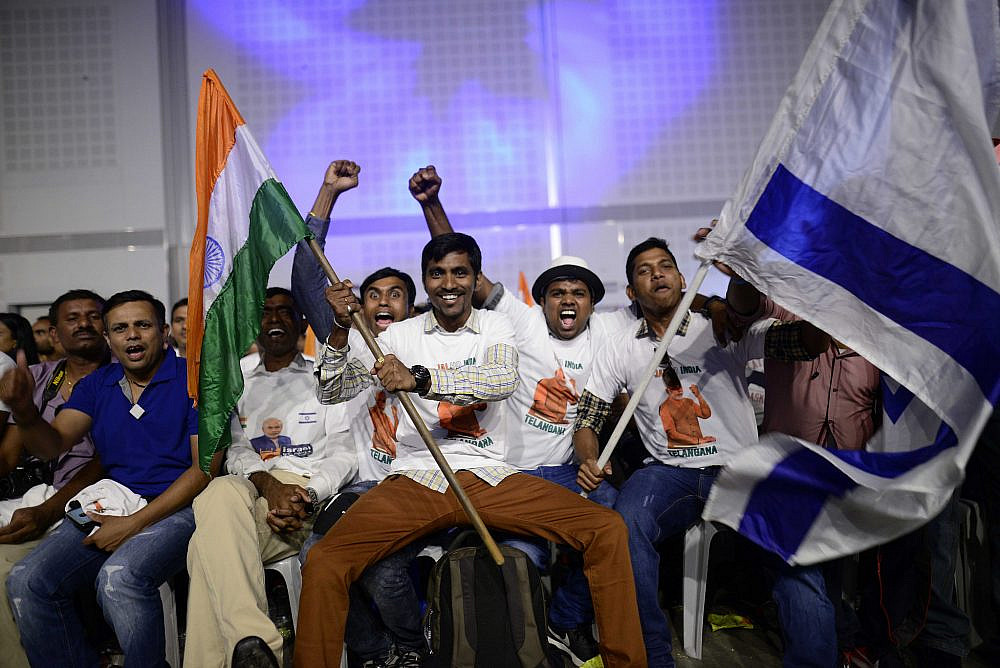
Indian flags are raised at rallies for Israel in the United States, and Israeli flags are raised on the streets of India during Hindu supremacist processions. Representatives of diaspora Hindu supremacist groups have included accusations of “antisemitism” in their attempts to smear their Muslim and pro-Palestine critics. Hindu supremacists and Zionists have joined forces in California to oppose ethnic studies curricula. Online, Hindu supremacists react to images of destruction in Gaza with glee, trending hashtags like #IndiaWithIsrael and #IslamIsTheProblem.
Ahmed also writes for Yaqeen Institute: “Much like Zionist groups, branches of violent Hindu militant groups like the Rashtriya Swayamsevak Sangh operate globally, from the United States to Canada and the United Kingdom to Kenya, forming a vast network of organizations known as the Sangh Parivar. These groups — which include cultural organizations, children’s programs, and political action committees — work to advance Hindu supremacist ideology among diaspora communities.”
How do Hindu supremacists replicate Zionist tactics of repression on Kashmiri Muslims?
The Muslim-majority region of Jammu and Kashmir has suffered under Indian military occupation for decades, the manifestations of which starkly mirror Israeli tactics of suppression in Palestine. In 2019, the Modi government revoked Article 370 of the Indian Constitution, stripping Kashmir of its special semiautonomous status and bringing the region under a full military crackdown.
Soon after, Sandeep Chakravorty, India’s consul general to New York City, proclaimed that India would build settlements modeled off the settler colonial project of Israel, saying, “If the Israeli people can do it, we can also do it.”
Kashmiri anthropologist Ather Zia writes, “Since 1947, India’s colonial project has focused on conquering, controlling, assimilating, and ultimately erasing Kashmiri indigeneity . . . The Indian government operates unimpeded under the guise of integrating the territory, development, and fighting Kashmiri resistance that is cast as terrorism or proxy war.”
“The dispossession of the natives, dense militarization, ecocide, brutality of troops, constant checkpoints, crackdowns, raids, encounters, and direct and indirect violence share uncanny similarities [with Palestine],” Zia adds.
Lawyer and writer Suchitra Vijayan similarly points out the overlap in India and Israel’s “demographic engineering, the criminalization of dissent . . . [and] shared infrastructures of violence: surveillance, digital repression, population control, and policing regimes that are increasingly modelled on each other’s practices.”
In the years since the revocation of Article 370, Kashmiris have suffered extrajudicial killings, torture by Indian military and police forces, wanton arrests, internet shutdowns, land seizures, the forced closure of mosques and house arrest of imams during Muslim holidays, and other human rights abuses. In 2024, the Modi government also introduced the Local Bodies Laws (Amendment) Bill, which would disenfranchise Kashmiri Muslims by offering government reservations to pro-BJP and upper-caste ethnic groups.
What can we do to combat the Hindutva-Zionist alliance?
Continue to get informed. Check out the following resources to deepen your understanding of the alliance between Hindutva and Zionism:
- •Use the information presented in this factsheet to connect with pro-Palestine organizers and coalitions at the grassroots level.
- •Use our Hindutva & Zionism presentation (available on our Factsheets & Presentations tab) to host educational events for your community — or request an event with an IMAM spokesperson.